"Let's Work Together": UE150 Sends Budget Proposal Letter to City Council

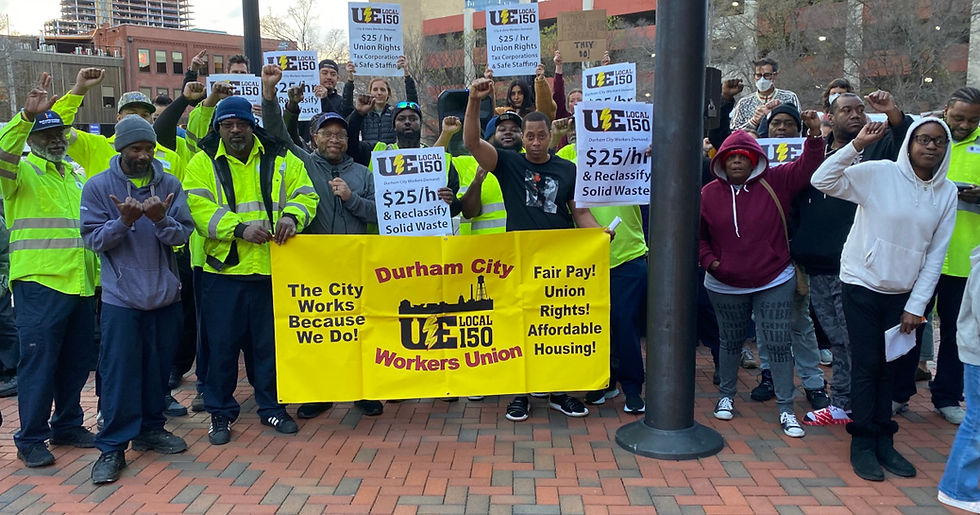
Dear Mayor Williams, City Council members and Manager Ferguson,
We remain committed to working collaboratively with you to continue our shared progress in recruiting and retaining the experienced workers who keep the City of Durham running. Over the past several
years, we have seen meaningful movement toward improving wages and protecting employee benefits. However, we continue to have significant concerns about equity and fairness-specifically regarding which groups of employees are receiving the largest share of wage-improvement investments. It has not been General Step Plan employees, despite the fact that these workers deliver our core services and
maintain the City's infrastructure.
With the rapidly rising cost of housing and healthcare, keeping pace with the Universal Living Wage Ordinance must be a major priority this year—particularly if we are to address wage compression as well. This is a challenge we are committed to solving together. We look forward to meeting with you and discussing the enclosed proposals in greater detail.
Yours for quality jobs and quality services,
Willie Brown, President, Durham City Workers Union, UE Local 150
FY 26-27 Budget Proposals
Raise the minimum wage for all city workers to $26.09 per hour. Maintain alignment with the Durham Livable Wage Ordinance.
End wage compression. Long-term employees should not be earning the same as new hires. Everyone should receive the same increase this year to restore fairness.
Fair step increases. Step raises should provide equal dollar amounts for every worker. Percentage-based systems only widen inequality.
Eliminate the unfair merit pay system. The current approach funnels bonus money to supervisors and leaves others behind. A simple "pass or fail" system, like Charlotte uses, restores fairness.
Commercial Driver's License (CDL) differential pay. Workers with special credentials, advanced licenses, or CDL qualifications should be compensated accordingly.
Protect our healthcare. Workers should not face premium hikes or increased out-of-pocket costs.
Raise minimum wage to $26.09 per hour based on the City of Durham's Livable Wage Ordinance
The Durham Minimum Livable Wage (DMLW) is calculated based on the average of the last four full years of the U.S. Department of Housing and Urban Development's (HUD) Fair Market Rent (FMR) data for a one-bedroom unit. The living wage calculation determines the hourly wage needed to afford housing and other basic expenses without spending more than 30% of income on housing.
Year | HUD FMR |
2025 | $1,637.00 |
2024 | $1,466.00 |
2023 | $1,250.00 |
2022 | $1,073.00 |
Formula: (1,637 + 1,466 + 1,250 + 1,073) / 4 / 0.3)) 12 / 2080 = $26.09 | |
Livable Wage History | ||
Current | FY2025 | FY2024 |
$21.90 | $19.58 | $18.46 |
End wage compression for Durham city workers
FY2026 General Employee Step Pay Plan | ||||||||||||
Grade | 1 | 2 | 3 | 4 | 5 | 6 | 7 | 8 | 9 | 10 | 11 | 12 |
A12 | $19.86 | $20.86 | $21.90 | $23.00 | $24.15 | $25.35 | $26.62 | $27.95 | $29.35 | $30.82 | $31.89 | $33.49 |
A13 | $21.14 | $22.20 | $23.30 | $24.47 | $25.70 | $26.98 | $28.32 | $29.75 | $31.23 | $32.79 | $33.94 | $35.63 |
B21 | $22.48 | $23.61 | $24.79 | $26.03 | $27.33 | $28.70 | $30.13 | $31.64 | $33.22 | $34.89 | $36.10 | $37.91 |
B22 | $23.91 | $25.11 | $26.37 | $27.69 | $29.08 | $30.53 | $32.05 | $33.65 | $35.34 | $37.10 | $38.40 | $40.32 |
B23 | $25.43 | $26.71 | $28.04 | $29.45 | $30.92 | $32.46 | $34.09 | $35.79 | $37.58 | $39.46 | $40.84 | $42.88 |
B24 | $27.51 | $28.88 | $30.33 | $31.85 | $33.44 | $35.11 | $36.87 | $38.71 | $40.65 | $42.68 | $44.17 | $46.38 |
B25 | $30.40 | $31.93 | $33.52 | $35.19 | $36.96 | $38.80 | $40.74 | $42.78 | $44.92 | $47.16 | $48.82 | $51.26 |
In FY2026, 28 employees in pay grade A12 (Step 1-2) and A13 (Step 1) were on steps that were compressed (gray). In FY2027, this number is going to be much higher (green), pending no market adjustment.
There are problems with compression. For instance, a senior heavy equipment operator (Maintenance Specialist Sr, B23) who is very skilled and trained on many pieces of equipment and holds CDL and other endorsements, would earn the same wage as a new laborer (A12) with no training or experience. Similarly, a new employee hired as a laborer (A12) would be making the same amount of money as an employee with 7 or more years of service. This often results in workers training workers who earn the same or even more than they do, causing great tension in the job. More senior workers and those with more experience resent this situation.
Fair step pay increases
Percentage-based raises are inequitable. We understand that different jobs require different levels of training and experience, and should be paid different amounts. However, awarding workers that are already higher wage earners a large dollar amount each year, masked as the same percentage, is not equitable.
For instance, when a worker earning a salary of $100,000 receives a 5% increase, they will witness a raise of $5,000. Compared to a worker making $44,000 per year who will only see an additional $2,200 increase in salary. The other problem with this scenario is that the city also disproportionately spends money on the raises for higher earners compared to lower wage earners.
Claiming that workers get the same percentage masks the truth that the actual dollar amount received is not equitable. This further creates divisions between pay of the city's low wage earners compared to the high wage earners.
The other problem with this scenario is that the city also disproportionately spends money on the raises for higher earners, compared to lower wage earners.
Ex. 1: Sanitation laborer | Ex. 2: Professional worker | |
Current salary | $44,000 | $100,000 |
5% raise | $2,200 | $5,000 |
Solution: Annual step increases for everyone based on median pay for the entire city.
This option would provide the most pay equity and distribute pay raises more evenly across all pay bands. This would not necessarily cost the city, as a whole, a lot more money, but it would provide the most equitable raises possible under the current pay system.
You would do this by identifying the median pay for all city employees and using that number to calculate the 5% step raise. If we recognize that our city's lowest-wage earners bear the greatest burden from rising housing, food, and childcare costs, then our pay system should reflect those values.
Eliminate unfair merit system
The current approach funnels bonus money to supervisors and leaves others behind. The current system relies on supervisors to heavily document each employee's work performance to justify a merit bonus. The net effect, is that managers and directors, who do not work on a daily basis directly with most workers, only award bonuses to supervisors who they have more direct contact.
CDL differential pay
Workers with special credentials, advanced licenses, or CDL qualifications should be compensated accordingly. Labor studies suggest that compensation practices involving differential pay are key strategies for the recruitment and retention of employees with commercial driver's licenses (CDLs), particularly in public sector and transit.
The City of Charlotte has offered a 2.5% CDL premium to employees whose job classifications require the license since July 2022.
Protect our healthcare
Workers should not face premium hikes or increased out-of-pocket costs. We understand that the cost of healthcare in North Carolina is rapidly rising. The recent negotiations between Duke and Aetna illustrate the increased drive for corporate profits. We implore the city to maintain its commitment to city employees by maintaining the current low premiums, co-pays and deductibles, so as not to further erode workers' income.
This article was first published by UE Local 150.



Comments